


-
Energy
4
-
Technical Trend
4
-
New innovative Material
5
-
Technical Solution
28
-
Flooring Solutions
12
-
Waterproofing Solutions
3
PHÂN BIỆT SỰ KHÁC NHAU GIỮA PIN LITHIUM LFP VÀ PIN LITHIUM TERNARY
1. Cấu tạo.
Lithium Iron Phosphate Battery (LFP)
The cathode material of lithium iron phosphate (LiFePO4) battery only uses lithium iron phosphate compound, does not contain heavy metals. Therefore,The positive material of lifepo4 battery has many sources, long cycle life, high safety index, relatively environmentally friendly, and lower cost.
– Pin Lithium LFP: Pin lithium sắt photphat là một loại pin lithium-ion Polymer sử dụng LiFePO4 làm vật liệu điện cực dương và cũng cần một điện cực âm Cacbon Graphit có lớp nền kim loại. Pin lithium sắt photphat, còn được gọi là pin LFP, là một loại pin có thể sạc lại. Loại pin này được đặc trưng bởi không có nguyên tố kim loại quý Coban.
Ternary Lithium Battery (NCM)
The positive electrode material of the ternary lithium battery generally uses three metal elements of nickel, cobalt, manganese, or aluminum, so it is also called a ternary polymer lithium battery. The higher the proportion of these metal elements, the greater the energy density. Unlike lithium iron phosphate, ternary lithium batteries have high voltage, which means that the specific energy and power of ternary lithium batteries are more significant for the same volume or weight. In addition, ternary lithium batteries also have significant advantages in large charging rates and low-temperature resistance. Ternary lithium batteries are more suitable for current and future household electric vehicles than lithium iron phosphate batteries.
– Pin Lithium Ternary: chỉ dùng một loại polymer có chứa ba nguyên tố kim loại là Lithium Nickel-Cobalt-Aluminium Oxide (NCA) hoặc Lithium Nickel-Manganese-Cobalt (NMC), là một hợp chất được sử dụng làm vật liệu cho điện cực dương pin lithium ion. Một điện cực Cacbon Graphit (than chì) có lớp nền kim loại sẽ được làm điện cực âm. Do hàm lượng niken cao của pin Lithium Ternary, dung lượng của pin có thể được tăng lên góp phần kéo dài khoảng cách về số lần sạc lại.


2. Mật độ năng lượng.
– Pin Lithium LFP: dao động ở mức 100-110 Wh/kg, cá biệt có thể đạt 130-150 Wh/kg, nhưng rất khó để bứt phá qua ngưỡng 200 Wh/kg.
– Pin Lithium Ternary: dao động ở mức 200Wh/kg và nó có thể đạt 300Wh/kg trong tương lai.
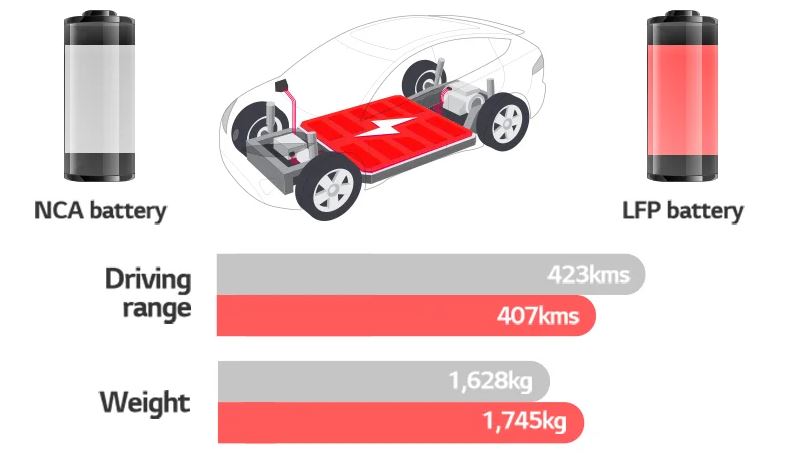
3. Khối lượng của Pin trong xe điện.
– Từ mật độ năng lượng đạt được, chúng ta có thể thấy rằng Pin Ternary có khối lượng nhẹ hơn với thời gian dùng lâu hơn so với Pin LFP.
4. Tính an toàn.
– Nếu có hiện tượng ngắn mạch bên trong pin của các thiết bị này hoặc toàn bộ bộ pin, thì tia lửa sẽ được tạo ra.Trong những vụ tai nạn va chạm cực mạnh và ngắn mạch sẽ gây ra hỏa hoạn. Tuy nhiên, vật liệu của sắt photphat sẽ không cháy trong trường hợp ngắn mạch và khả năng chịu nhiệt độ cao của nó tốt hơn nhiều so với pin Lithium Ternary. ⇒ LFP an toàn hơn
5. Nhiệt độ khi khởi động.
– Mặc dù pin Lithium Ternary có khả năng chịu nhiệt độ cao nhưng khả năng chịu nhiệt độ thấp của nó là thứ đáng được lưu tâm và đây là lý do kỹ thuật mà các nhà sản xuất pin lithium ở nhiệt độ thấp. Ở âm 20 ° C, pin Lithium Ternary có thể giải phóng 70,14% dung lượng, trong khi pin sắt photphat chỉ có thể giải phóng 54,94% dung lượng. Hơn nữa, nền tảng phóng điện của pin lithium bậc ba cao hơn nhiều so với pin sắt photphat ở nhiệt độ thấp do nó di chuyển nhanh hơn.
6. Hiệu suất sạc.
– Hiệu suất sạc của pin Lithium Ternary cao hơn pin LFP. Sạc pin Lithium là sử dụng phương pháp giới hạn dòng điện và điện áp, nghĩa là sạc dòng điện không đổi trong giai đoạn đầu khi dòng điện lớn và hiệu suất cao. Cụ thể hơn là khi sạc ở 20 độ C, tỷ lệ dòng điện không đổi của pin Lithium Ternary là 52,75% và tỷ lệ dòng điện này lớn hơn gấp 5 lần so với pin LFP là 10,08%.
7. Tuổi thọ Pin.
– Về tuổi thọ theo chu kỳ sạc thì tuổi thọ của pin LFP tốt hơn pin Lithium Ternary. Tuổi thọ lý thuyết của pin lithium bậc ba là 2000 chu kỳ sạc, nhưng dung lượng giảm xuống còn 60% sau 1000 chu kỳ. Trong khi pin LFP có 80% dung lượng sau cùng số lần sạc tương đương.


Tóm tắt về tính năng của 2 loại trên (LFP vs NCM) vào bàng so sánh:

⇔ Pin LFP bền hơn, an toàn hơn, thân thiện môi trường hơn, tuổi thọ dài hơn, tuy nhiên Ternary thì nhẹ hơn, sạc nhanh hơn, hiệu xuất sạc cao hơn
Lithium Polymer Battery
Lithium polymer batteries use positive and negative data, and liquid lithium-ion is the same. Positive data is divided into lithium cobalt acid, lithium manganese acid, ternary data, and lithium iron phosphate data. Negative electrode graphite, battery operation principle is also common. The principle of lithium polymer battery is the same as liquid lithium, and the first difference is that the electrolyte is different from liquid lithium. The primary structure consists of three elements: a positive electrode, negative electrode, and electrolyte. The so-called polymer lithium-ion battery means that at least one or more of these three primary structures use polymer materials as the primary battery system. The polymer data are mainly applied to the positive electrode and electrolyte in the current lithium-ion polymer battery system.

Conclusion
Compared with LFP vs NCA vs NCM, the thermal stability of the ternary battery is poor, the LFP battery has strong thermal stability and lower requirements for BMS and long cycle life, so car companies use the LFP battery solution.
Compared LFP vs NCA vs NCM, for NCA and NCM, the performance of NCA battery is better, but because of the lower thermal runaway temperature, it requires higher manufacturing process. NCM batteries have a higher thermal runaway temperature, which can reduce the production process requirements, so it has become the main research and development direction of manufacturing companies
Compared LFP vs NCA battery, which has relatively mature technology, high power and high energy density. NCA battery can be said to be an ideal power battery becaus of higher energy density and better stability and consistency. On the other hand, 18650 can effectively reduce the cost of the battery system
Compared with LFP vs NCA vs NCM, NCA is the latest and best performing ternary cathode material. NCM and other ternary materials, as power battery cathode materials, will gradually become the winners of lithium-ion battery cathode materials with strong market competitiveness in terms of cost performance, capacity, and high rate characteristics, and will replace the main cathode materials for other batteries currently on the market.
So với LFP vs NCA vs NCM, NCA là vật liệu catốt ba cực mới nhất và hoạt động tốt nhất. NCM và các vật liệu bậc ba khác, với tư cách là vật liệu cực âm của pin điện, sẽ dần dần trở thành người chiến thắng trong vật liệu cực âm của pin lithium-ion với khả năng cạnh tranh thị trường mạnh mẽ về hiệu suất chi phí, công suất và đặc tính tốc độ cao, đồng thời sẽ thay thế vật liệu cực âm chính cho các vật liệu khác pin hiện có trên thị trường.

